Facts checked Nov 20, 2026 against the sources listed below.
A century of music in one canyon in the Hollywood Hills. Dates come from the Bowl's own history timeline, built from the LA Phil archives, and from Wikipedia's article on the Bowl; where the two disagree, both are given at the end.
Before the Bowl
The idea came from pageants. In 1916 a one-night outdoor Julius Caesar in Beachwood Canyon, staged for the Shakespeare tercentenary with thousands of performers, convinced Hollywood it needed a permanent amphitheatre. Two years later Christine Wetherill Stevenson, heiress to the Pittsburgh Paint Company, staged The Light of Asia in the hills. In 1919 her Theatre Arts Alliance bought 59 acres in Bolton Canyon, a picnic spot also known as Daisy Dell, in the Cahuenga Pass.
Stevenson left the Alliance in 1920 over its purpose. The Community Park and Art Association, founded on October 25, 1920 with F. W. Blanchard as president and Artie Mason Carter as secretary, took over and bought the land. By then people were already calling it the Hollywood Bowl.
1921–1922: the first concerts
The Bowl's timeline dates the first Los Angeles Philharmonic performance there, and the first Easter Sunrise Service, to March 21, 1921, with LA Phil founder William Andrews Clark Jr. and its first music director, Walter Henry Rothwell. On Armistice Day that November came the Women's World Peace Concert.
The first stage was a wooden platform under canvas, with movable benches. A pre-season Carmen in July 1922 paid for the first seats, and on July 11, 1922 Alfred Hertz, the "father of the Bowl", conducted the LA Phil's opening concert of the first "Hollywood Bowl Summer Concerts", with Wagner, Tchaikovsky, Brahms, Grieg, Kreisler and Rossini's William Tell overture. Blanchard's slogan was that "popular prices will prevail", and tickets cost 25 cents, according to Wikipedia.
The 1920s: boxes, broadcasts and Lloyd Wright
The first 150 box seats went in in 1923. In 1924 the land was deeded to the County of Los Angeles, which still owns it. In 1925 Fritz Reiner brought "shockingly new" Stravinsky and Honegger, Sir Henry Wood gave the West Coast premiere of Holst's The Planets, and Ethel Leginska became the first woman to conduct at the Bowl.
Myron Hunt, designer of the Rose Bowl, gave the seating its elliptical shape in 1926, the year a Pacific Electric line on Highland Avenue made the Bowl easy to reach. In January 1927 the LA Phil became the first major American orchestra to broadcast an entire concert on the radio, from the Bowl. Box holders that summer included Cecil B. DeMille, Charlie Chaplin and Louis B. Mayer.
A century of shells
The stage cover has changed more than anything else. Allied Architects built the first arched proscenium in 1926; it caused more acoustic problems than it solved. Lloyd Wright, son of Frank Lloyd Wright, designed a pyramid for 1927, controversial and gone at season's end, then in 1928 a shell of nine concentric arches that could be tuned panel by panel, an acoustic success that water damage later ruined.
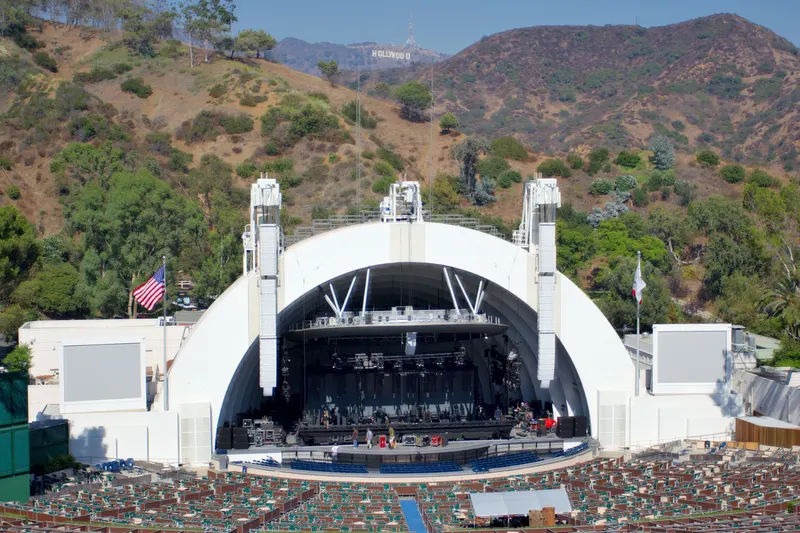
The 55-ton shell of 1929, engineered by Elliot, Bowen and Waltz and built by Allied Architects, became the Bowl's icon; it sat on rails so tractors could move it. To fix its sound, Frank Gehry and acoustician Christopher Jaffe added cardboard sonotubes in 1970, which blocked the view and drew protests, and in 1980 replaced them with hanging fiberglass spheres. After the 2003 season the old shell came down, and the larger shell by Hodgetts + Fung, part of a seismic and backstage rebuild planned from 2000, opened in 2004. Its first LA Phil concert marked 70 years since Max Reinhardt's A Midsummer Night's Dream.
The 1930s and 1940s
Reinhardt's 1934 Midsummer Night's Dream moved the shell and trucked in earth for a forest hill; Mickey Rooney and Olivia de Havilland were in the cast and Erich Wolfgang Korngold ran the music. In 1936 William Grant Still became the first African American to conduct a major American orchestra there, and soprano Lily Pons set an attendance record. Benny Goodman brought jazz to the Bowl in 1939, the year the Tea Room was built on Peppertree Lane as a WPA project.
George Stanley, who sculpted the Oscar statuette, designed the granite Muse of Music fountain at the entrance in 1940. Audiences were limited during the war. In 1942 Rachmaninoff walked on stage to thank Vladimir Horowitz after his Third Concerto, and on August 14, 1943 Frank Sinatra became the first pop singer to appear with the LA Phil. Leopold Stokowski became the first music director of the Hollywood Bowl Symphony in 1945.
1951–1969: crisis, pool and the pop era
In 1951 an expensive Die Fledermaus run closed the season after one week; Dorothy Chandler's emergency committee reopened it 12 days later. A reflecting pool was built in front of the stage in 1952 and later given a fountain. Otto Klemperer conducted the Bowl's 1,000th concert, Beethoven's Ninth, in 1953, and in 1956 Ella Fitzgerald, Louis Armstrong, Art Tatum and the Oscar Peterson Trio made the first jazz recording at the Bowl.
Rock and roll arrived in 1958. Judy Garland sang through the rain in 1961, Bob Dylan debuted in 1963, and in August 1964 The Beatles filled the Bowl after a single newspaper ad and word of mouth; they came back for two nights in 1965, and Capitol released The Beatles at the Hollywood Bowl in 1977. The Doors, Jimi Hendrix, The Who, Simon & Garfunkel and Janis Joplin followed. The Tchaikovsky Spectacular with fireworks became a yearly tradition in 1969.
1970–1999: Gehry, films and new festivals
Deep Purple played with the LA Phil in 1970, the first rock band to do so at the Bowl. The pool was drained in 1972 to protect the sound and the players' instruments; the box section that replaced it is still called the Pool Circle. The LA Phil's Star Wars concert with lasers in November 1977, six months after the film opened, began the Bowl's habit of film music, and John Williams first conducted there in 1978.
The first Playboy Jazz Festival came in 1979, the Monty Python troupe filmed a show for the cinema, and the museum opened in the old Tea Room in 1984. Mariachi USA launched in June 1990. In 1991 the Hollywood Bowl Orchestra was founded as a separate ensemble under John Mauceri, who led it until 2006. A multi-phase renovation from 1995 rebuilt the stage area, entrance plaza and museum, which reopened in 1996 as the Edmund D. Edelman Hollywood Bowl Museum.
2000 to today
The Hollywood Bowl Hall of Fame began in 2000 with John Williams and Garth Brooks. Gustavo Dudamel made his American debut at the Bowl in September 2005, aged 24, and became the LA Phil's music director in 2009. New LED screens arrived in 2012 and the boxes were redone in their 1930s style in 2015.
In May 2020 the season was cancelled for the first time in 98 years. The Bowl reopened in May 2021 with a free concert for frontline workers, and Kool & the Gang headlined that summer's July 4th Fireworks Spectacular, the first show with a full house again. The Bowl was listed on the National Register of Historic Places in 2023, and in 2025 its stage was named for John Williams, a first in the venue's history. The LA Phil's 104th season at the Bowl ran in summer 2026.
Where sources disagree
- The first Easter Sunrise Service: the Bowl's timeline says March 21, 1921; Wikipedia says November 11, 1921, the date the Bowl gives for the Women's World Peace Concert.
- Monty Python: Wikipedia dates the performance to 1980; the Bowl's timeline lists it under June 1982, the year the film Monty Python Live at the Hollywood Bowl came out.
- Biggest crowd: the Bowl credits Lily Pons (1936) with the attendance record for a single concert; Wikipedia calls the 1956 Jazz at the Philharmonic night the best-attended event in Bowl history.
- Who designed the 1929 shell: both sources name Allied Architects as builder; the Bowl also credits the engineers Elliot, Bowen and Waltz with the design.
Questions
When did the Hollywood Bowl open?
Its official opening concert was July 11, 1922, with Alfred Hertz conducting the Los Angeles Philharmonic.
Who designed the current Hollywood Bowl shell?
Hodgetts + Fung; it opened in the 2004 season.
Did Frank Lloyd Wright design the Hollywood Bowl?
No. His son Lloyd Wright designed the 1927 and 1928 shells.
When did the Beatles play the Hollywood Bowl?
In August 1964 and on two nights in 1965; the live album came out in 1977.
Who owns the Hollywood Bowl?
Los Angeles County, since 1924; the LA Phil runs it with the county.
Sources
Checked Nov 20, 2026.